Evaluating facelift scars
From Dr. Garth Fisher
Easy tip-offs to facelift surgery include the obvious pulled "too hard" or in the "wrong direction" look. Additional tip-offs include avoidable alterations in the hairline and the anatomy of the ear. These areas demand the most attention to detail by the surgeon and should be meticulously preserved. Photograph "A" below highlights the 7 critical areas to scrutinize and preserve to achieve a natural result after cosmetic surgery in Beverly Hills. Dr. Fisher holds himself to the highest standard to spend the necessary time and effort to achieve the best facelift Beverly Hills can lay claim to.
Photograph "A" shows a woman’s ear after a facelift with a scar carelessly placed in front of her ear. The surgeon was either in too much of a hurry, had no artistic sense at all, or had no sensitivity towards a patients desire to conceal the scars. Bad scarring, scars in noticeable areas, distorted anatomy, and distorted hairlines all cause anxiety and the feeling of vulnerability for patients, especially in intimate situations. These scars should be avoided at all cost by a careful and meticulous surgeon. Below is a guide to evaluate facelift scars and the 7 critical areas of anatomy, which should be preserved.
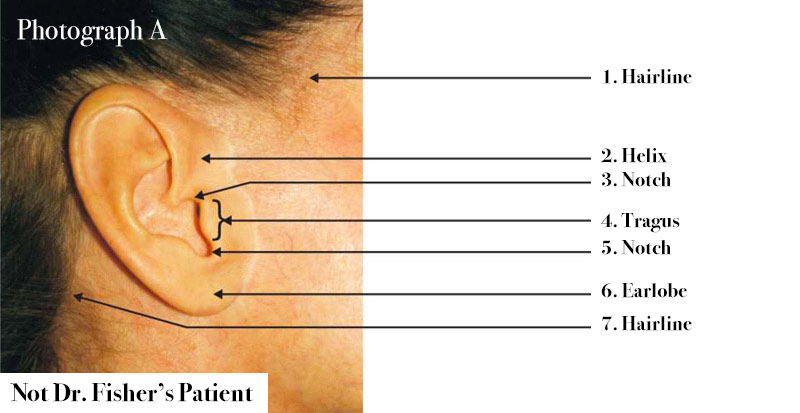
Numbers 1 and 7: The temporal hairline (1) in front of the ear and the hairline behind the ear (7) should be maintained after surgery. Poor planning and execution of facelift surgery often distorts both, leaving patients very vulnerable and limited regarding their hairstyles. Some women cannot even wear their hair back with carelessly placed scars.
Numbers 2-5 show the four critical areas to maintain free of distortion. Number 2 is gentle curved tube like part (helix) at the front of your ear (helix root). Number 3 is the gentle notch or indentation above the tragus. Number 4 is the tragus, which is the small piece of cartilage covered by skin which projects into the ear. This little flap-like projection is the portion of the ear that most often has its anatomy deformed and distorted. Number 5 is the U-shaped notch that is just below the tragus, which is crucial to maintain perfectly so the tragus can look normal.
Number 6 is the location, shape, and direction of pull of the earlobe itself. Very often, the earlobes are stretched and pulled forward unnaturally (pixie ears).
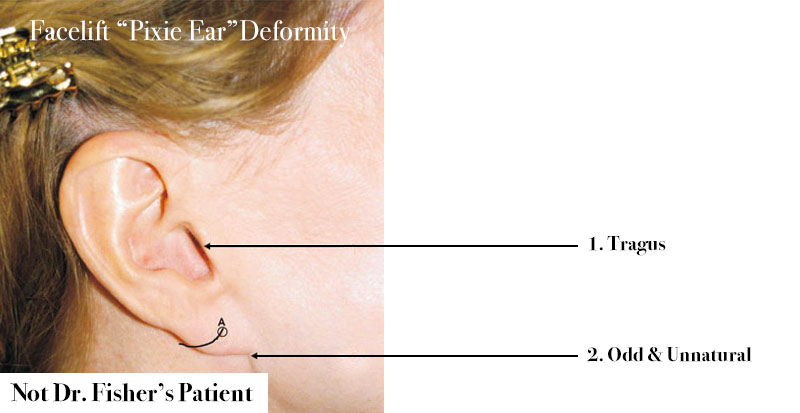
Photograph B shows and example of a pixie ear that unfortunately is seen too commonly. Point (A) at the small circle, is where the earlobe should have been placed. Yet it is misshapen and stretched to an odd and unnatural location (arrow #2). Note that the tragus (arrow #1) has been destroyed and lost its identity as well.
Photos C,D,E,F
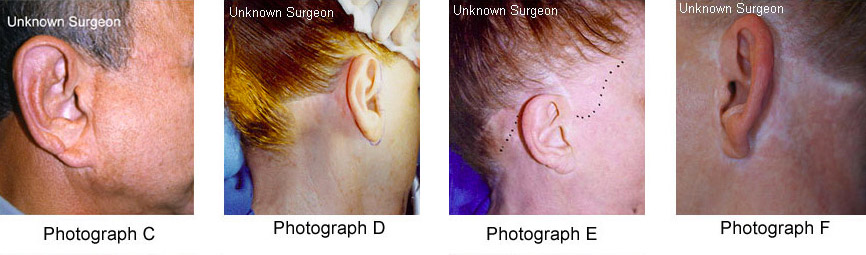
The traditional facelift scars below were poorly planned and executed. As a result, the scars are very noticeable. The hairline and natural anatomy of the ear are distorted. Although it saves time for the surgeon, it is difficult to conceal for a patient’s lifetime, leaving the patient feeling vulnerable with diminished hairstyle options. In Photo "E", well-intended attempts to hide the scars in the hair have permanently displaced and distorted her hairline. The dotted line indicates the original location of her hairlines prior to surgery. (Note: surgeries performed by another surgeon).
Photos CC, DD, EE, FF
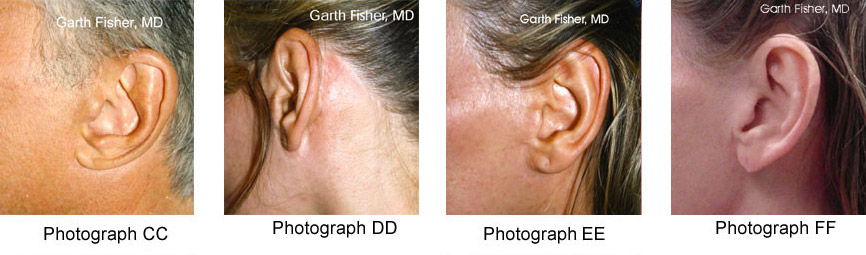
The facelift scars below (Courtesy of Garth Fisher MD, FACS) blend in with the natural anatomy of the ear and hairline. These are carefully placed free of tension, in cosmetically silent areas along natural anatomical contours. Although time consuming, these are very difficult to see at close scrutiny and allow patients the freedom to wear their hair with any style including ponytails. This is most critical for men with short hairstyles.
Conclusion
Now that you have a better understanding of what to look for, you should be more critical of the work of the surgeons you are considering. Most of these undesirable issues are avoidable by proper planning and execution of incisions and avoidance of excessive tension on the skin. As one of the best plastic surgeons in the US, I consider myself obligated to spending the required time necessary to focus on these detailed and very critical elements of facelift surgery. You should also understand that I thoroughly enjoy spending this time in the operating room achieving proper results for patients who place their trust in my ability.