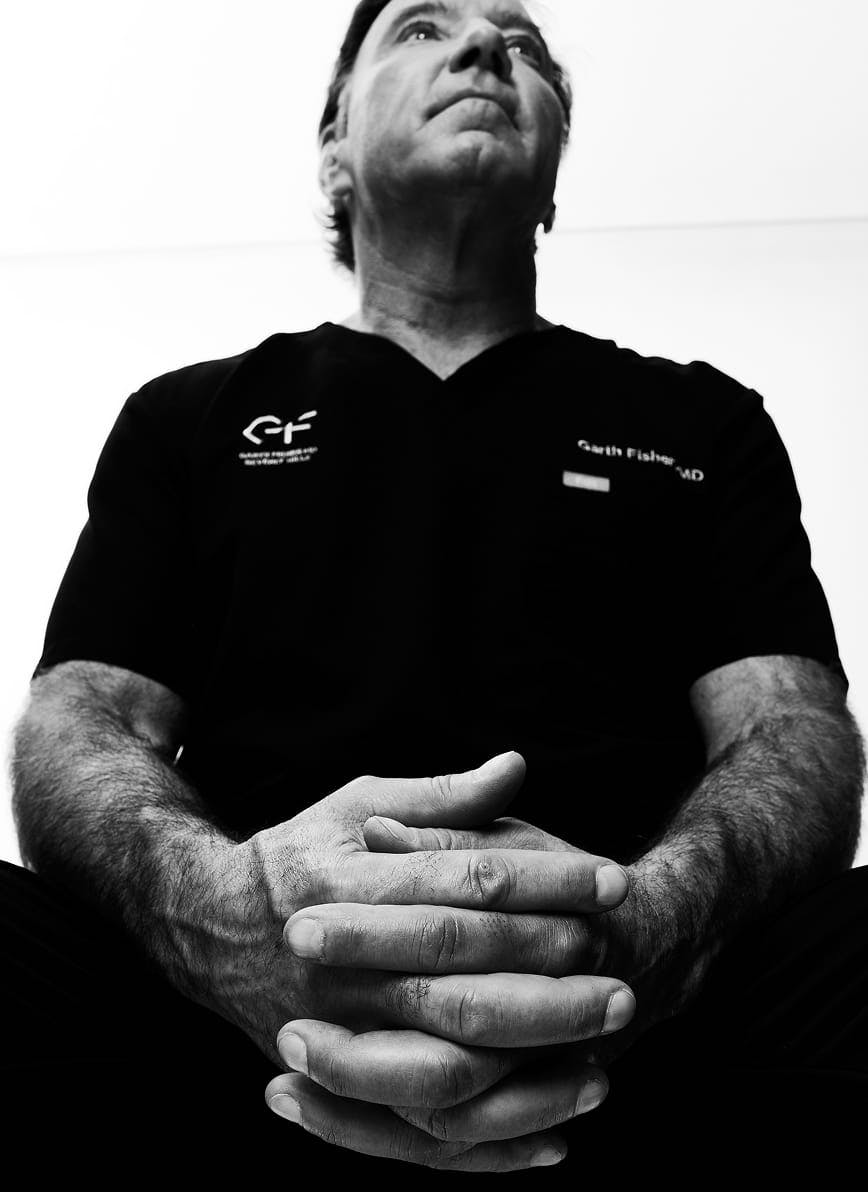
Garth Fisher M.D.® F.A.C.S.
Board Certified Plastic Surgeon
Beverly Hills, California USA
CellCeuticals® Skin Care Inc
Cofounder and Chairman
Biomedical Skin Treatment Institute®
Founder and Director
2009 NEW BEAUTY BREAST INTERVIEW
What are the main changes that occur over time to the breast?
Not all women or their breasts age the same however in general there are some predictable changes that occur. The breast becomes less dense with firmer breast tissue becoming replaced with less firm fatty tissue. The skin envelope loses elasticity and volume creating drooping and deflation. This leads to breasts that are less firm, perky, and of a less desirable volume and shape. Breast feeding and significant and repeated weight loss can make these changes occur more markedly and rapidly. These findings are less demonstrative in patients with thicker skin or with smaller bra sizes like an "A" or a "B".
When it comes to breast augmentation, what factors should you take into consideration?
I think a patient should be very educated regarding the options, risks, and alternatives regarding breast augmentation surgery. The benefits of this surgery are easy to live with but patients should not forget about the risks. Not only should they be very familiar with the risks, but also be financially capable of dealing with them if they occur. The most common potential downside of augmentation surgery is the possible development of capsular contracture or formation of tight scar tissue around the implant. This can cause pain and distortion of the breast and may require future surgery to correct. I think it is important to find a plastic surgeon who performs many of these operations and whom has before / after photos that reflect the "look" that the patient wants to achieve. Patients should understand that bra sizing is an inconsistent communication tool that is used and in general can not be promised.
Why are projection and shape, in addition to size, important to consider with an augmentation?
The majority of patients I see want to have a natural shape regardless of size. Size is only one variable. Implants have different projection profiles with some being more projecting then others. I personally do not prefer the "look" of the high profile or more projecting implants. An advantage with these implants however is that one can put a larger volume in a patient with a narrower chest or breast space. These high profile implants have a narrower base than a less projecting implant of the same volume. Implants also come in a round or "anatomic" shapes. With my personal technique, I achieve a very natural shape without the undesirable drawbacks I associate with the shaped implants. These types of issues have a lot to do with personal preference and the surgeon's unique operative technique. Many patients and surgeons are delighted with higher profile and anatomic implants. You have to thoroughly discuss these topics with your personal surgeon.
Please explain the different incision options and placement options and what the pro and con is for each.
Implants can be safely and effectively placed though axillary (armpit), periareolar (under nipple), inframammary (under breast), or periumbilical (belly button approach). You might obtain a totally beautiful or really terrible result utilizing any of these incision options depending on the judgment and skill of your surgeon among other factors. Your surgeon will let you know what he or she is comfortable with. If the incisions are closed in a meticulous fashion in a patient with good healing potential, all these locations can produce "good scars" which are less noticeable. I have always felt however that the periareolar location provides the highest percentage of "good" scars as there is an opportunity to blend in with the transition color of the areola. Even if the patient is going to heal poorly, this is the only location not typically exposed to the general public. (Often bathing suits can ride up exposing the inframammary scar.) The inframammary location is a common and excellent choice for many and ideal for placement of larger, anatomic shaped or very cohesive implants.
The nerve that provides nipple sensation plugs into the right breast at 9oclock and the left breast at 3 o'clock. Hence, periareolar incisions made below these landmarks should not eliminate sensation. The corresponding nerve that supplies this sensation can be stretched or damaged from excessive lateral dissection from any of the four incision options noted above. This can lead to temporary or permanent loss of nipple sensation. Thus, loss of sensation often has more to do with the size of the implant than the location of the scar. Larger implants requiring more dissection from any incision increase the risk of nerve damage.
Inframammary, axillary, and periumbilical incisions are less damaging to the breast ducts than the periareolar incision. Although any surgery on the breast could potentially affect breast feeding, patients with all of the above incisions typically can breast feed.
Silicone implants require larger incisions than their saline counterparts and can not be placed through belly button incisions. Some have difficulty placing these through axillary incisions as well. I am not a fan of periumbilical incisions and have yet to hear a compelling reason why this technique choice outweighs its risk.
In general, aside from a simple implant exchange, reconstruction or secondary surgeries such as correcting a capsular contracture should be done through the periareolar or inframammary incisions.
Why are silicone implants becoming so popular now?
I think silicone implants were always popular however since they were restricted for use for almost 20 years, they were less commonly used. The plethora of studies has shown that they are safe and are now well accepted. Generally speaking, silicone implants feel more natural than saline implants and might "ripple" less. It is important to note that these two advantages are mainly realized in patients with thin skin or little breast tissue. Saline implants can feel comparable in patients with thicker skin and more breast tissue. Both saline and silicone implants can provide a very natural looking breast as this virtue has more to do with the technique than the type of implant.
Are you seeing a trend to more natural looking breasts?
My particular patients have always asked for natural looking breasts as that is the type of breast shape that I have always been most known for creating. I think in general, patients are more educated and discriminating now as their "breast augmentation IQ" has risen. Implant manufacturers and surgeons have also learned and evolved a great deal in the past 20 years and are better equipped and trained now to satisfy these deserving patients.
What are some new trends/ techniques in terms of augmentation, lifts, and reduction?
New trends in augmentation have mainly centered around new technology in implants. Implants have become more durable, of varying shapes and gel consistency. There are simply more options now for patients with different needs and anatomical limitations.
I don't feel there has been any ground breaking trends regarding lifts. All surgeons and patients want to limit the extent of scarring without compromising the end goal and result. This applies to breast reductions as well. In some patients, liposuction maybe appropriate to reduce the size of the breast or in combination, reduce the extent and location of scarring. The "magic wand" has still not been created.
How can liposuction be used for breast reduction? Is this a typical procedure? Are there any instances when it can not be used?
One of the potential advantages of liposuction is to reduce the size of the breast without having extensive scars from the associated skin reduction. Some surgeons will perform liposuction in select patients to reduce the volume and then perform more of a "breast lift" on the remaining breast.
Liposuction is best utilized for breast reduction in a patient who is not undergoing a large reduction, has little extra skin with good elasticity, desirable nipple size and location, and has fatty breast tissue amendable to suctioning. However, patients who typically want breast reduction for functional reasons have associated excess skin on their breasts and nipples that are too low. Liposuction will not treat or correct these issues. Traditional reduction techniques are also more useful for evaluating breast tissue sent to pathology than liposuction techniques. This is important for cancer surveillance.
What is the benefit of placing an implant in during a lift? Does it result in less scars and if so why?
Generally, skin has to be removed in some geometric pattern to raise, lift, or tighten a breast. If an implant is added during a lift, the implant "accommodates" some of the extra skin leaving less that has to be removed. Thus, in some cases, the extent and location of the scars can be modified or reduced. Another advantage of an implant is that it will provide more firmness, substance, and fullness to the end result breast.
Twitter - Glossary - Facebook - Contact Dr. Fisher
Web Development by Imaginary Trout